Remelia

What it teaches Years 3–6

Key Stage 2 maths and English for the 11+, Years 3 to 6.

Remelia teaches Key Stage 2 maths and English as 199 maths objectives (177 from the national curriculum) and 90 English objectives, in the order your child’s school teaches them. Here is every part of it, counted, and what it does not teach.

Open the appHow it works

Opens in this browser — use your child’s device. No account needed to start.

Maths

Every Key Stage 2 maths objective, and problem solving beyond it.

177 objectives from the national curriculum for Years 3 to 6, in 10 strands, and 22 more on solving problems and thinking mathematically. All 199 have their own questions.

The 10 Key Stage 2 strands

  • 26 objectives

    Number and place value

    Years 3–6

    For example Round any number to the nearest 10, 100 or 1,000

  • 11 objectives

    Addition and subtraction

    Years 3–5

    For example Add and subtract numbers up to 3 digits using formal columnar methods

  • 19 objectives

    Multiplication and division

    Years 3–5

    For example Recall and use multiplication and division facts for the 3, 4 and 8 tables

  • 40 objectives

    Fractions, decimals and percentages

    Years 3–6

    For example Recognise mixed numbers and improper fractions and convert between them

  • 28 objectives

    Measurement

    Years 3–6

    For example Read, write and convert time between analogue and digital 12- and 24-hour clocks

  • 27 objectives

    Geometry

    Years 3–6

    For example Describe positions on a 2-D grid as coordinates in the first quadrant

  • 8 objectives

    Statistics

    Years 3–6

    For example Interpret and present data using bar charts, pictograms and tables

  • 9 objectives

    Calculation

    Year 6

    For example Use knowledge of the order of operations (BIDMAS) to carry out calculations with all four operations

  • 4 objectives

    Ratio and proportion

    Year 6

    For example Solve problems involving the calculation of percentages (e.g. 15% of 360) and the use of percentages for comparison

  • 5 objectives

    Algebra

    Year 6

    For example Express missing number problems algebraically

Problem solving, and thinking beyond Key Stage 2

10 objectivesEvery year

Problem-solving strategies

Habits for any worded or multi-step question, practised alongside the topics of every year.

  • Break a complex problem into a series of simpler steps, and persevere
  • Decide which operation to use and why
  • Estimate and use rounding to check an answer for reasonableness
  • Work backwards from a given answer
  • Eliminate wrong multiple-choice options by logical deduction
  • Recognise patterns and sequences
  • Draw a diagram / table to simplify a problem
  • Read a rule or formula given in the question and apply it to an unfamiliar situation
  • Trial and improve when the method isn’t obvious
  • Find a second method and use it to confirm the first
12 objectivesBeyond Key Stage 2

Mathematical thinking

Puzzles that stretch past the Key Stage 2 curriculum, for the kind of question that asks a child to find a way in rather than follow a method.

  • Systematic listing
  • Working backwards
  • Spotting invariance
  • Proof by exhaustion
  • Counterexample
  • Generalisation
  • Bar modelling / diagram-first
  • Estimation and sanity-checking
  • Elimination under multiple choice
  • Elegance
  • Perseverance on a stuck problem
  • Explaining and justifying

In the order of your child’s school’s scheme

Maths is taught half-term by half-term in the order of the scheme your child’s school follows. If you are not sure which one that is, Remelia follows White Rose Maths.

  • White Rose Maths (the default)
  • Power Maths
  • Maths — No Problem!

When an answer is wrong in a way that matches a known misunderstanding, the app says what probably happened, in words a child can use next time.

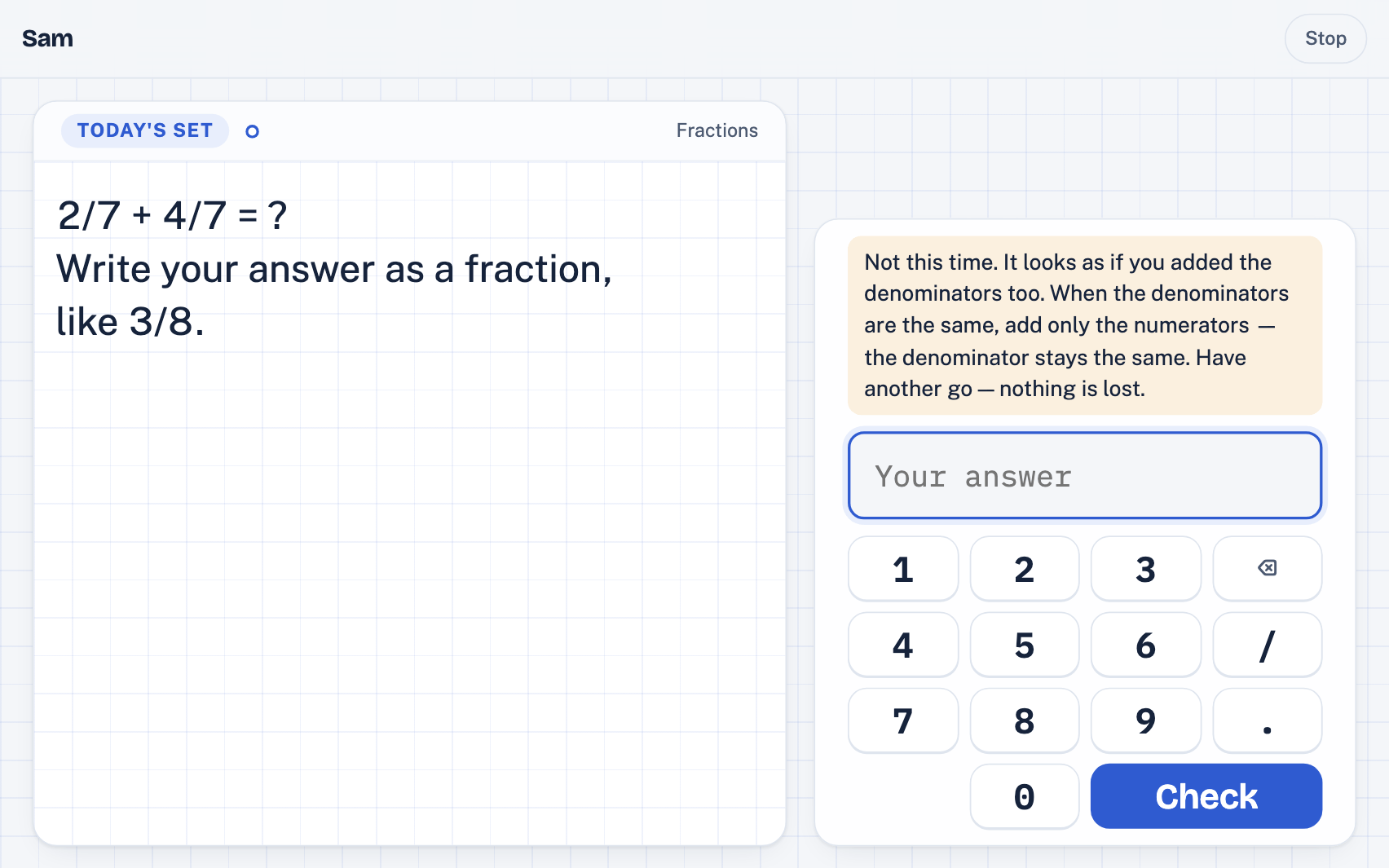
A maths question in the app: 2/7 + 4/7. Beside it the feedback reads: “Not this time. It looks as if you added the denominators too. When the denominators are the same, add only the numerators — the denominator stays the same. Have another go — nothing is lost.”
A fractions question, and the mistake it names. From the app, for a made-up child called Sam.
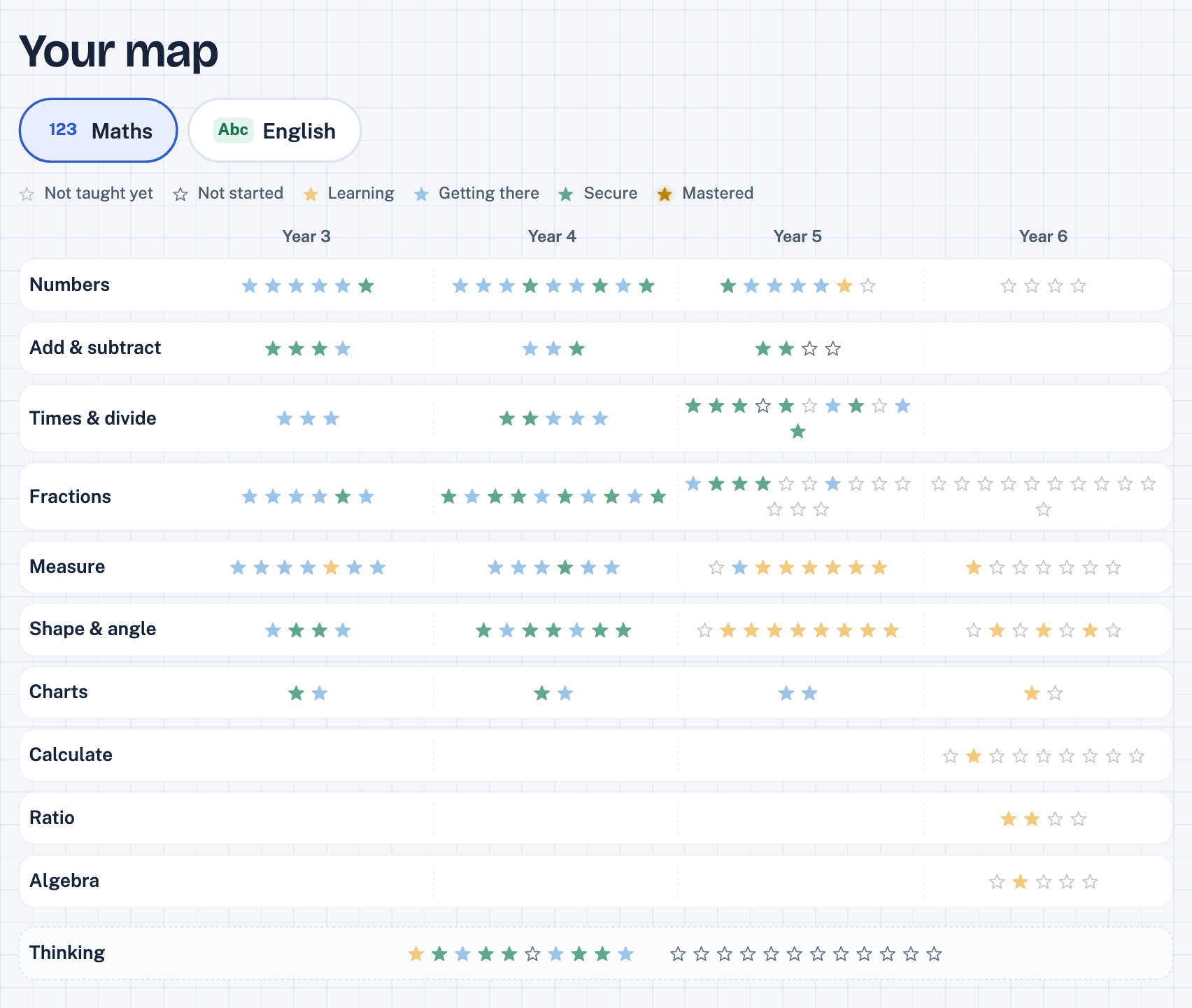
The child’s map in the app, on its Maths tab: a star for each objective, in rows by strand (Numbers, Add and subtract, Times and divide, Fractions, Measure, Shape and angle, Charts, Calculate, Ratio, Algebra) and columns for Years 3 to 6, with a separate Thinking row. The stars are coloured by stage, from not taught yet to mastered.
The map a child sees: every objective as a star, by strand and year.

Every objective, on one map

Your child sees the whole syllabus as a map of stars, one per objective, filled in as topics become secure. Maths and English each have their own.

Topics school has not reached yet are shown as not taught yet, so a gap never looks like a failure.

English

The same English for every child, and more when the exam asks for it.

90 objectives from the Key Stage 2 English curriculum, Years 3 to 6. Whichever school your child is aiming for, 73 of them are practised in the daily questions, and from Year 4, spring term there is a passage each week to read with a grown-up. The reading day and the timed writing come in only when a chosen exam tests them.

Every session, for every child

Daily questions

73 objectives, a few questions in each session beside the maths. They need no chosen exam, and you can turn English on or off in the parents’ app.

  • 10 Word Years 3–6The grammatical difference between plural and possessive -s
  • 11 Sentence Years 3–6Fronted adverbials
  • 10 Text Years 3–6Correct choice and consistent use of present tense and past tense throughout writing
  • 11 Punctuation Years 3–6Apostrophes to mark plural possession
  • 27 Spelling Years 3–6Homophones and near-homophones, Years 3–4 list
  • 4 Vocabulary Years 3–5Synonyms and antonyms; similar and opposite word families

Spelling covers the rule families and the statutory word lists for Years 3–4 and 5–6.

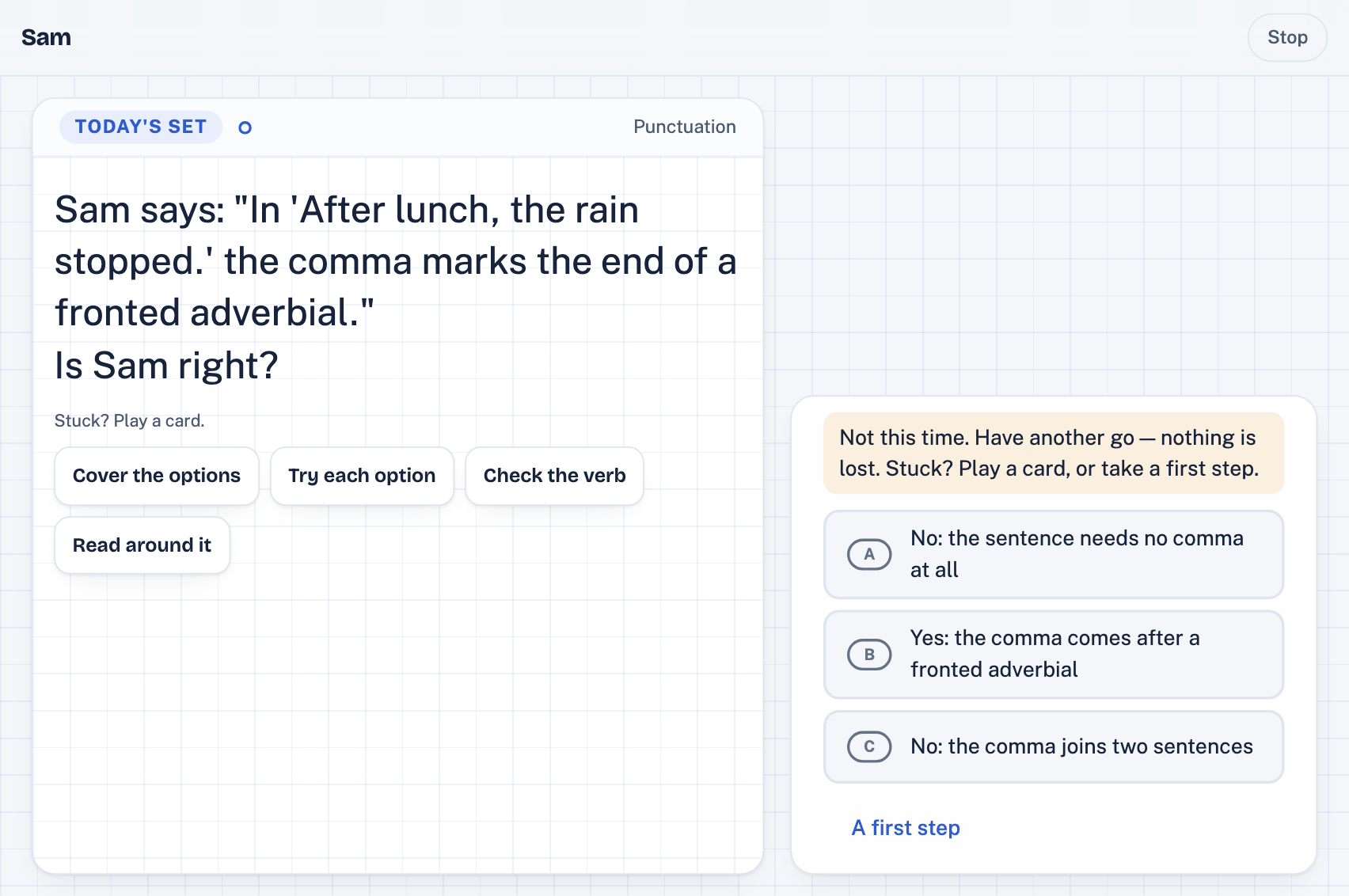
An English question in the app, labelled Punctuation: “Sam says: In ‘After lunch, the rain stopped.’ the comma marks the end of a fronted adverbial. Is Sam right?” with three answers to choose from, strategy cards to play, and the feedback “Not this time. Have another go — nothing is lost.”
A punctuation question on fronted adverbials, after a first wrong try.

Once a week

Reading

For every child, from Year 4, spring term: a passage to read together with a grown-up, with three questions for the grown-up to ask. It needs no chosen exam.

A reading day, from Year 5, autumn term, when a chosen exam tests English (of the exams with a plan, Trafford grammar schools (FSCE)): one day a week the practice is a passage your child has not seen before and 9 questions on it. The questions practise 11 reading objectives: finding information, working out what characters think and feel, predicting what happens next, summing up the main ideas, why the writer chose the words and telling fact from opinion.

passages in the bank
130
non-fiction
67
fiction
46
poems
17

Both come from the same bank. Prose passages run from about 250 to 450 words; the poems are shorter. 20 are classic texts out of copyright, the rest written for Remelia. A passage is never shown twice.

When a chosen exam has writing: fortnightly from Year 4, spring term, weekly from Year 5, autumn term

Short timed writing

A piece of 6 to 10 minutes against a clock: “What happened next?”, “What would you do?” and “Describe it”, from 36 prompts. Your child writes it on paper, so nothing written goes into the app, and hands it to a grown-up, who ticks what the piece shows:

  • An idea of their own
  • A clear beginning and end
  • A sentence that starts with a fronted adverbial
  • An expanded noun phrase
  • Speech punctuated
  • Tense kept

It comes in when a chosen exam includes a written piece: of the exams with a plan, Trafford grammar schools (FSCE) and The King’s School, Chester (Quest). A tick counts as evidence, never as a right answer: it cannot make a topic look secure.

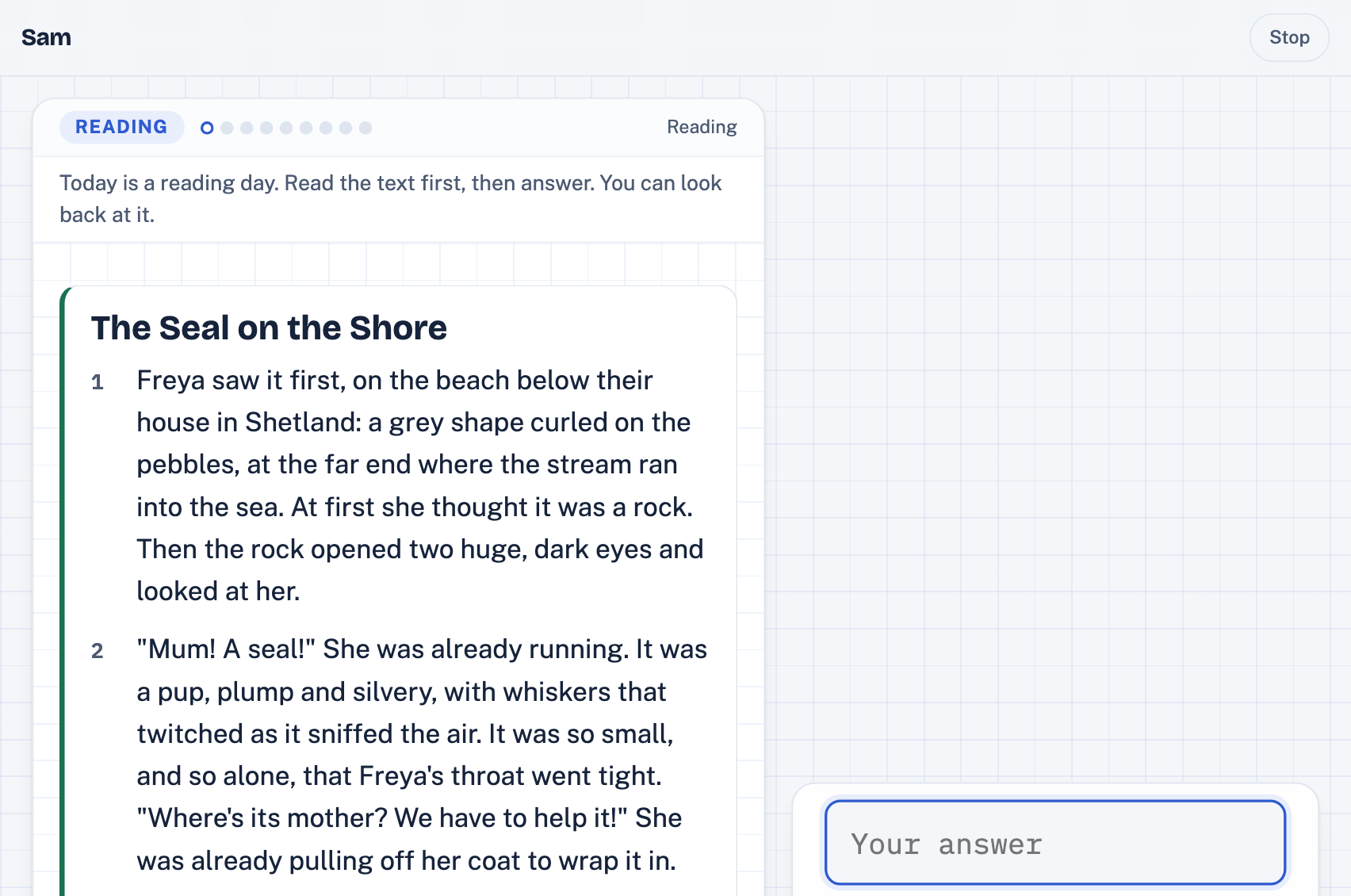
A reading day in the app: the passage “The Seal on the Shore”, with numbered paragraphs, and an answer box beside it. The note at the top says: “Today is a reading day. Read the text first, then answer. You can look back at it.”
A reading day: the passage stays on screen while your child answers.

What a reading day looks like

The passage stays on screen, with its paragraphs numbered, while your child answers; they can look back at it as often as they like. A wrong answer gets a second go and the usual feedback.

A kind of reading question that keeps going wrong is asked first on the next reading day, on a new passage, so the practice goes where it is needed.

Year by year

What each school year holds.

The objectives in each Key Stage 2 year. The 22 maths objectives on problem solving and mathematical thinking belong to no one year, so they are counted apart.

Objectives in Remelia by school year and subject
School yearMathsEnglishBoth
Year 3322557
Year 4422163
Year 5543286
Year 6491261
Problem solving and thinking22–22
All19990289

The years an exam counts

An exam plan counts the years its exam covers:

Year 6 is taught either way: for an exam that stops at Year 5 it is stretch, never a requirement.

Each exam plan is dated from your child’s year group: Remelia works to the sitting for the September they start Year 7. For a school without a plan, choose “Not sure yet” and Remelia teaches the Key Stage 2 curriculum with no exam date.

In school order

Up to a term ahead of school, and no further by default.

Remelia works just in front of the class: a topic is met here shortly before or while school teaches it, and brought back afterwards so it stays. You tell it your child’s school year; a starting check on the first day finds where your child actually is.

  • Closest to school

    Only what school has taught

    For a child who would rather meet everything in class first.

  • The default

    Up to a term ahead

    Two half-terms in front of the class, counted on your child’s school year and its terms.

  • Widest

    The whole year

    Anything in the years in scope, whenever school gets to it.

A grown-up chooses in the parents’ app. In the final months before a chosen exam, the limit lifts on its own so that everything the exam covers can be reached. English has no published half-term order, so it goes year by year.

Not taught

What Remelia does not teach.

So that you know what to cover some other way.

Verbal and non-verbal reasoning

Neither is taught. Remelia teaches two subjects, maths and English, and nothing else. If your child’s exam has a reasoning paper, that will need practice elsewhere.

English with no questions

2 English objectives have no questions: Year 3 “themes and conventions in a wide range of books” and Year 5 “identify and discuss themes and conventions”. They are about reading whole books, and are listed in the parents’ syllabus as having no questions.

The 4 composition objectives have no questions either: they are practised in the timed writing, which a grown-up marks.

Parts of an exam the app does not cover

  • The King’s School, Chester (Quest): non-verbal reasoning, English reading comprehension, a thirty-minute written English paper (the short writing pieces practise part of it), Quest’s Creative Comprehension section and Quest’s Puzzles and Problem-Solving section (the puzzles here practise some of it).

The parents’ app says the same beside each school you choose. Schools and exams

Preparing for a school that is not listed? The Key Stage 2 maths and English curriculum is still taught in school order: grammar, punctuation, spelling and vocabulary in every session, and from Year 4, spring term a passage each week to read with a grown-up. The reading day, the writing and a dated exam plan come with the listed schools; ask for yours at info@remelia.co.uk.

See where your child is.

A short starting check on the first day places your child in the syllabus, and the plan starts from there.

Open the appHow it works

Opens in this browser — use your child’s device. No account needed to start.